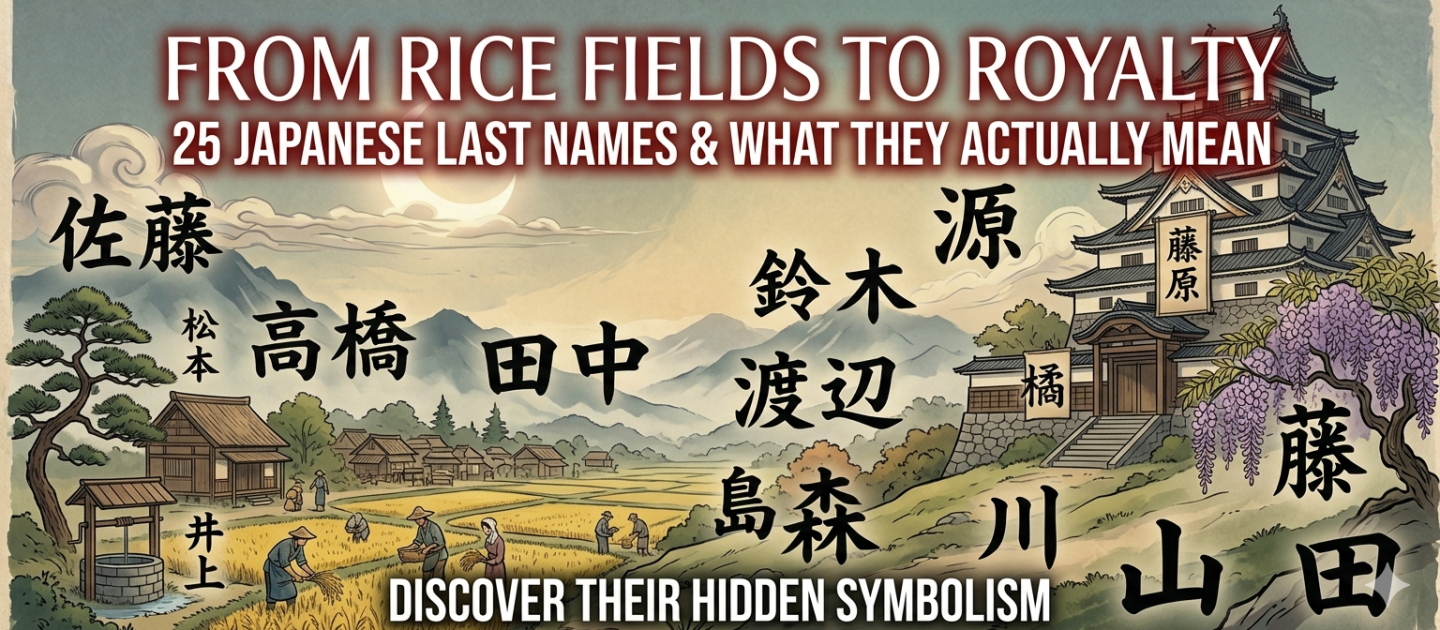
In many Western cultures, we usually pick a last name because it sounds good with a first name. But in Japan, surnames carry the weight of history, geography, and family roots. Until the late 1800s, most people in Japan didn’t even have official last names. Only samurai, nobles, and wealthy merchants were allowed to use them.
Today, there are over 100,000 Japanese surnames. Almost every single one tells a story about where a family lived hundreds of years ago. Whether you are building a character for a story or you just want to understand why names like Sato or Tanaka are everywhere, this guide breaks it down simply.
If you want to see how these last names look when paired with a first name, you can test them out on our Japanese Name Generator.
The “Big Three” of Japanese Surnames
If you walk down a busy street in Tokyo, you are almost certain to meet someone with one of these three names. They are the most common family names in the country.
- Sato (佐藤): This is the number one most common name in Japan. It is linked to the powerful Fujiwara clan from ancient times. The name combines the idea of an “Assistant” with the “Wisteria” flower.
- Suzuki (鈴木): This name means “Bell Wood.” It actually comes from the wooden piles used during rice harvesting. It is a name deeply rooted in Japan’s farming history.
- Takahashi (高橋): This one simply means “High Bridge.” It started as a way to describe families who lived near a famous or tall bridge in their village.
Names Born from the Land
Most Japanese last names are “topographical.” This means they describe the physical landscape where the family originally lived.
- Tanaka (田中): This means “Middle of the Rice Field.”
- Yamamoto (山本): This means “Base of the Mountain.”
- Ishikawa (石川): This means “Stone River.”
- Mori (森): This simply means “Forest.”
If you are creating a character who is a rugged woodsman or a quiet village healer, these “earthy” names feel much more natural and real.
Noble and Samurai Surnames
If you are writing about a high-ranking official or a legendary warrior, you need a name that sounds heavy and important. These names usually come from the ruling class.
- Minamoto (源): One of the most famous clans in Japanese history. The name means “The Origin” or “The Source.”
- Fujiwara (藤原): Meaning “Wisteria Field.” For centuries, this was the most powerful family in the Japanese royal court.
- Tachibana (橘): This means “Wild orange.” It was a prestigious name often given to high-ranking nobles by the Emperor himself.
- Shimazu (島津): A powerful warrior clan from the south. They were famous for their fierce samurai.
The Order Matters: Why the Last Name Comes First
In Japan, the family name always comes first.
If your character’s family name is Sato and their given name is Kenji, their full name is Sato Kenji. This is because Japanese culture focuses on the family and the ancestors before the individual. When you use our name generator, we keep this traditional order to make sure the results look authentic.
Why the Meaning Matters
Picking a name like Watanabe (which means “to cross a border”) for a character who is a traveler or a merchant adds a hidden layer to your story. It makes your world feel like it was built with a purpose.
Ready to find a match? Head over to the Japanese Name Generator to see how different family names change the whole feel of a character.